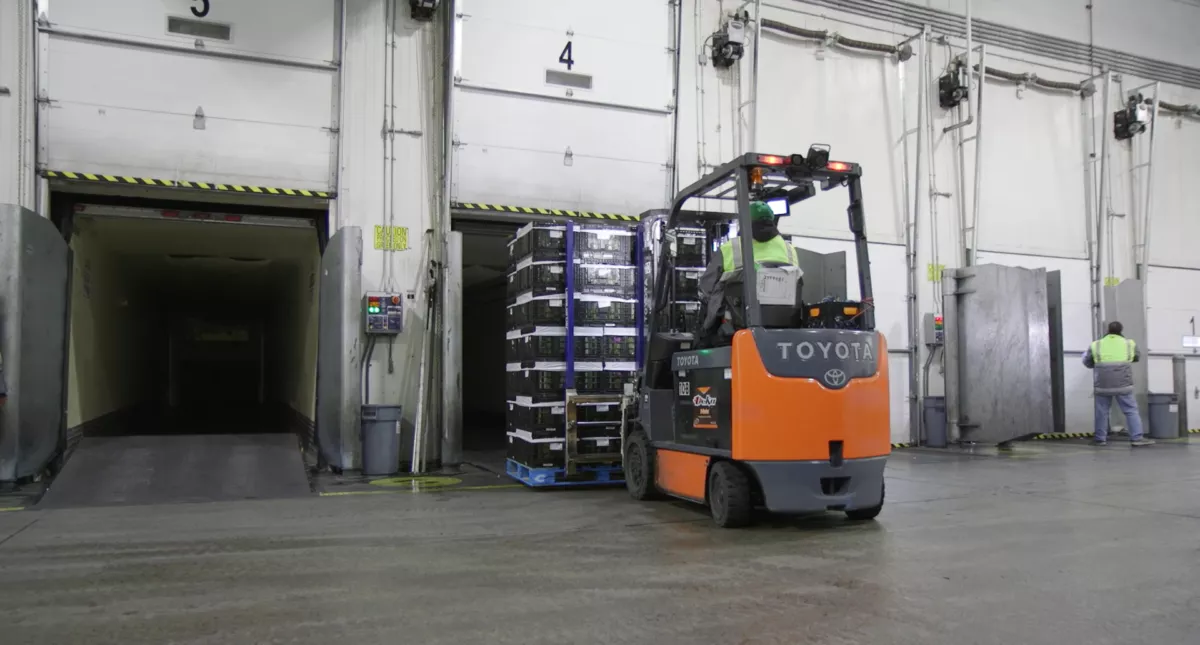
It is Thursday afternoon and your production line is running. Product is coming out of the field and it needs to go somewhere, whether that’s into a box, a bag, or whatever the specific packaging configuration that Costco, Walmart, or the regional grocer on the east coast requires. Because here is the thing about fresh produce: every retailer has different packaging requirements, different labeling, and different size specs.
However, the EDI order from Walmart does not land for four more days until Tuesday. You are packing now on a Thursday because you have to: the product is ready, the field does not wait, and harvest happens when the harvest happens. So you make your best guess about what is coming next week and you pack accordingly.
Guess right, and Tuesday is a non-event. Guess wrong, and it's a repacking job — which means paying labor twice, paying packaging costs twice, and watching shelf life burn off while your crew fixes a mistake that didn't need to happen. Sometimes there isn't enough of the right product left to even cover the order, so you are calling a neighboring operation and buying at a margin you never budgeted for. And if the retailer notices the pattern, what's really at stake is the delivery reliability you spent years building with that account.
This is not an edge case. For most growers, packers, and distributors, it's just how the job runs. Decisions are made on instinct and whatever the production manager happens to remember from last year.
And that is really the issue. The operators who've run Famous Software the longest are sitting on years of order history inside their ERP: what Costco ordered in week 27, what the east coast accounts needed the second week of July. Right now, those patterns live in one person's head, surfacing in a Thursday-morning meeting as a hunch — "we usually see a big Costco run this time of year, let's get ahead of it." That knowledge is real, but it's fragile. It walks out the door when that person retires.
That institutional knowledge -- the "we always get a big Costco run this time of year, let's get ahead of it" conversation that happens in a morning meeting -- is exactly what Famous Production Optimization is being designed to formalize. Not replace. Formalize. Take the pattern that lives in one person's memory and surface it as a data-driven recommendation before anyone has to remember to ask.
The system looks at the year-over-year trend for each account, identifies the week, the commodity, the volume, and the packaging configuration -- and tells your production team, ahead of the EDI drop, what to pack and for whom. Not with 100% certainty. With 90% confidence based on everything that has actually happened in your operation. Your team still makes the call. The AI tells them what the data says.
The 20% that requires human override -- the customer who changed their packaging spec mid-season, the account that went quiet because of a contract renegotiation, the edge case that no historical pattern could have predicted -- that is still yours. That will always be yours.
But the 80% that is just math? The pattern recognition that your best production planner does in their head every Thursday afternoon? That should not be living in one person's memory. It should be in the system. It should be available to everyone on the line. And it should be getting smarter every season, not walking out the door when someone retires.
Famous has been building the data infrastructure for this for 50 years. The order history is there. The commodity data is there. The customer specs and packaging requirements are there. Production Optimization is the intelligence layer that will connect them into a recommendation before you have to guess.
The question is not whether you want to stop guessing on Thursday afternoons. Every grower and packer in this industry does.
The question is whether you will have the system to stop guessing before your competitor does.
To learn more about how our predictive planning will optimize packing and production before orders even enter the system, take a look here.